Open Source Dark Web Monitoring Tools vs a Paid Feed: What Each Covers
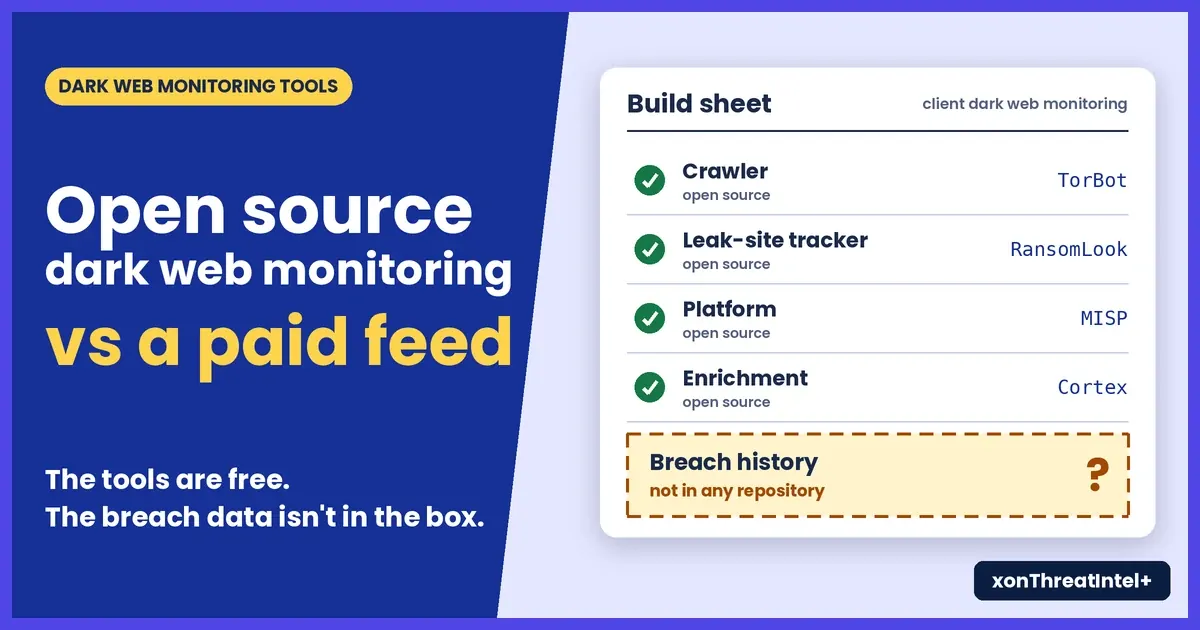
Open source dark web monitoring means building the service yourself out of free projects: a crawler for onion sites, a tracker for ransomware leak pages, a platform such as MISP to hold whatever turns up. The projects are real, and a few (MISP and the AIL framework, for two) are very good.
What none of them ships is a searchable, checked history of past breaches. And that's what answers a client who asks whether their staff logins are out there.
So open source gives you the collectors and the workbench. The records themselves, already found, parsed, checked and matched to a domain, are what a paid breach feed sells. A breach feed does that one job, though: it doesn't watch forums for a company's name, and it doesn't track actors.
On 23 November 2026 we went through 32 open-source projects, repository by repository. They're the ones that tool lists and search results on this topic name most, plus the platforms they feed.
Fifteen had a commit in the six months before that date. Three were slower, eleven were dormant and three had been archived by their owners.
You should know we aren't neutral. We run XposedOrNot , a free and open-source breach search service that's been in the open since 2017. We also run xonThreatIntel+, the paid feed built on the same index for people who watch other companies' domains.
What do clients mean by "dark web monitoring"?
Three different jobs sit under that one label. It helps to pull them apart before choosing any tool.
- Exposed logins. Staff email addresses and passwords sitting in breach dumps, combolists and stealer logs.
- Mentions. The company's name turning up on a forum, in a Telegram channel or on a ransomware leak site.
- Watching the sites themselves. Which markets and forums are up, who moved where, what a group is posting.
In our experience an SMB client nearly always means exposed logins, even when the sales deck they saw was all forums and markets. Open-source tools are strongest on mentions and on watching the sites. The logins job needs a collection of breach data behind it.
What open-source dark web monitoring tools do, job by job
The table below sorts the projects by job and says what you'd still have to bring yourself.
| Job | Open-source projects | What you get | What you still bring |
|---|---|---|---|
| Crawl and search onion sites | TorBot , TorCrawl.py, Ahmia , darkdump, Robin | Links, page text, search results | Tor and seed addresses for the crawlers (Ahmia's hosted search needs neither; Robin also needs a language model key), and a place to keep the output |
| Collect leaks as they appear | AIL framework with its Lacus crawler | Crawled pages and chats, with email addresses and credentials pulled out | A server, your own list of sites, accounts and rules. Nothing from before the day you start |
| Track ransomware leak sites | RansomLook , ransomware.live | Which group named which company, and when | Very little if you use the hosted sites. The stolen files themselves aren't indexed |
| Know where to look | deepdarkCTI | A kept-up list of forums, channels and leak sites | The crawlers, logins and analysts to work through that list |
| Look up an email or a domain | theHarvester, SpiderFoot, h8mail | For breach lookups, a front end that asks other services for you | Keys for third-party lookup services, or your own breach files |
| Store, enrich, share, alert | MISP , OpenCTI, Cortex, IntelOwl, Wazuh | The workbench: events, enrichment, correlation, alerts | A server, somebody to run it, and data to put in it |
The lookup row surprises people, because those tools hold no breach data of their own. h8mail's README opens by calling it "an email OSINT and breach hunting tool using different breach and reconnaissance services, or local breaches". The answer comes from a service you hold a key for, or from files you collected.
For the logins job, in other words, the real choice is which data sits behind the script.
AIL comes closest to doing the data work itself. It crawls, and its feature list has a line reading "Extraction of URLs, hostnames, email addresses and credentials".
But it collects only what you point it at, starting the day you switch it on. A breach from 2019 that's still doing the rounds won't be in there unless you go and fetch it.
Which open-source projects are still maintained?
More of them than we expected, which is mostly good news.
| Status on 23 November 2026 | Count | Projects |
|---|---|---|
| Commit in the last six months | 15 | TorBot, Ahmia, TorCrawl.py, Robin, theHarvester, RansomLook, deepdarkCTI, MISP, OpenCTI, Cortex, IntelOwl, Wazuh, AIL framework, Lacus, ail-feeder-telegram |
| Slower (last commit 7 to 15 months back) | 3 | darkdump, ransomware.live (the hosted site is still updating), WhatBreach (one commit since 2019) |
| Dormant (no commit in two years, or marked unmaintained in the README) | 11 | OnionScan (2017), PasteHunter (2021), breach-parse (2021), h8mail (2022), pystemon (2022), VigilantOnion (2023), OnionSearch (2023), SpiderFoot (2023), holehe (2024), Fresh Onions, Telepathy |
| Archived by the owner | 3 | OnionIngestor, ransomwatch, TheHive |
Source: each project's public repository on GitHub, read 23 November 2026. The year in brackets is the newest commit on the default branch. Fresh Onions and Telepathy carry no year because their READMEs say they're unmaintained, although housekeeping commits still appear.
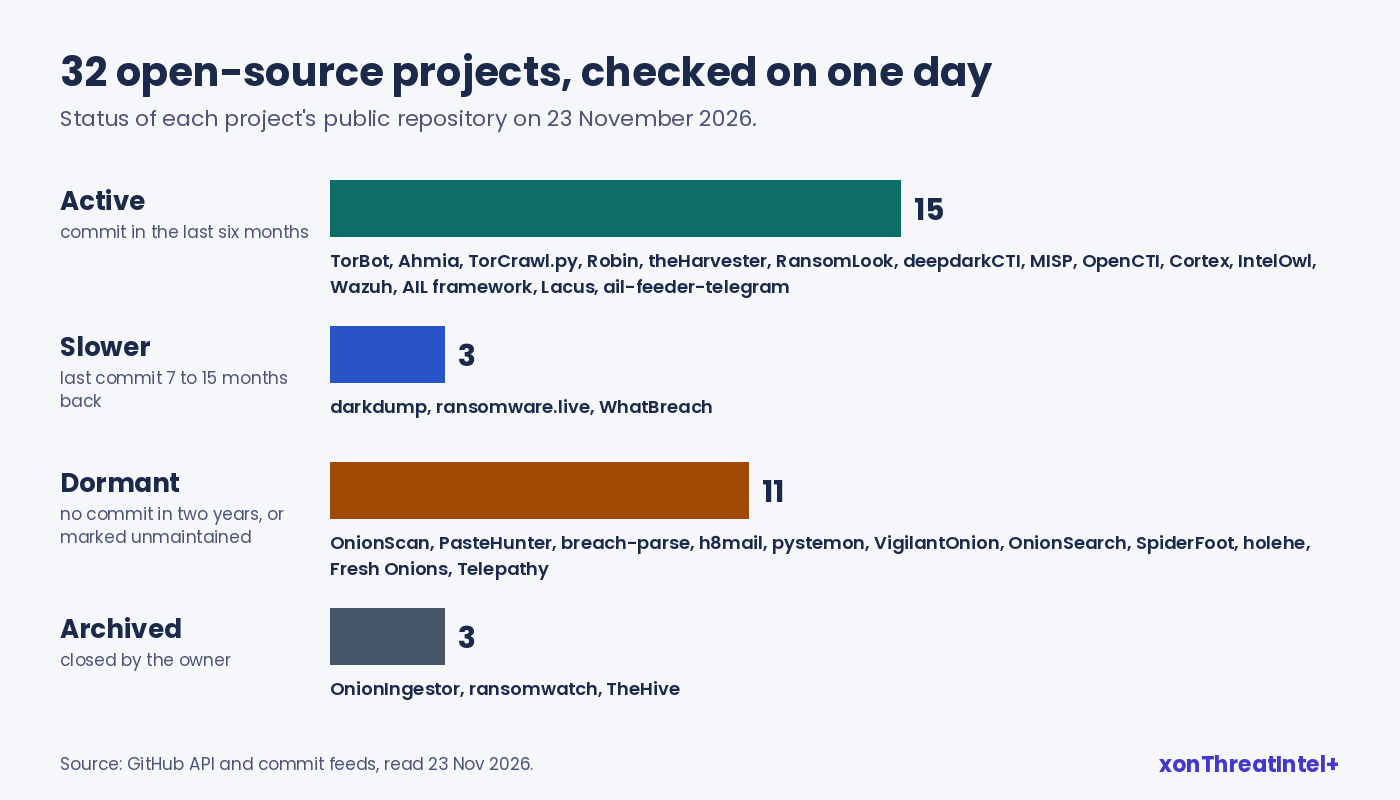
The platforms with an organisation behind them are still shipping: MISP, OpenCTI, Wazuh, AIL and Cortex all had commits in October or November. The dormant list is mostly small crawlers, paste monitors and lookup scripts. One of them, holehe, gets listed as a breach tool but only tests whether an address is registered on a site.
What does that mean for you? One small check before you promise anything to a client: open the repo and read the date of the last commit.
Licences deserve the same two minutes. TheHive's repository now says it "is now distributed as a commercial version", and the vendor's licence page limits the free edition to non-commercial use. An MSSP can't treat it as free, though Cortex, its enrichment engine, is still open.
OpenCTI is open core, with a Community Edition under Apache 2.0 and an Enterprise licence beside it. And three projects on our list (VigilantOnion, WhatBreach, breach-parse) carry no licence file at all.
Where does the breach data come from?
Suppose the tooling all works. You still need the breaches.
Somebody has to find each dump, get hold of it and decide whether it's real. After that comes a layout nobody documented and a lot of duplicates, and every record still has to be tied to a domain. We do that work for our own index, so we can tell you what a year of it looked like.
| One year of breach data work | 52 weeks to 23 November 2026 |
|---|---|
| Breaches added to our index | 147 |
| Separate days on which one arrived | 106 |
| Records added | 1,234,651,677 |
| Smallest and largest entry | 5,600 and 299,646,818 records (the largest is a stealer-log set) |
| Median breach size | 862,530 records |
| Different kinds of exposed data | 44 |
| Breaches that included passwords | 35 |
| Breaches that had happened before 2025 | 37 |
| Median gap, breach date to our index | 73 days |
Source: XposedOrNot public catalog, pulled 23 November 2026. Counts are records, and one person can sit in many breaches; our data page explains the counting. Breach dates are recorded by month.
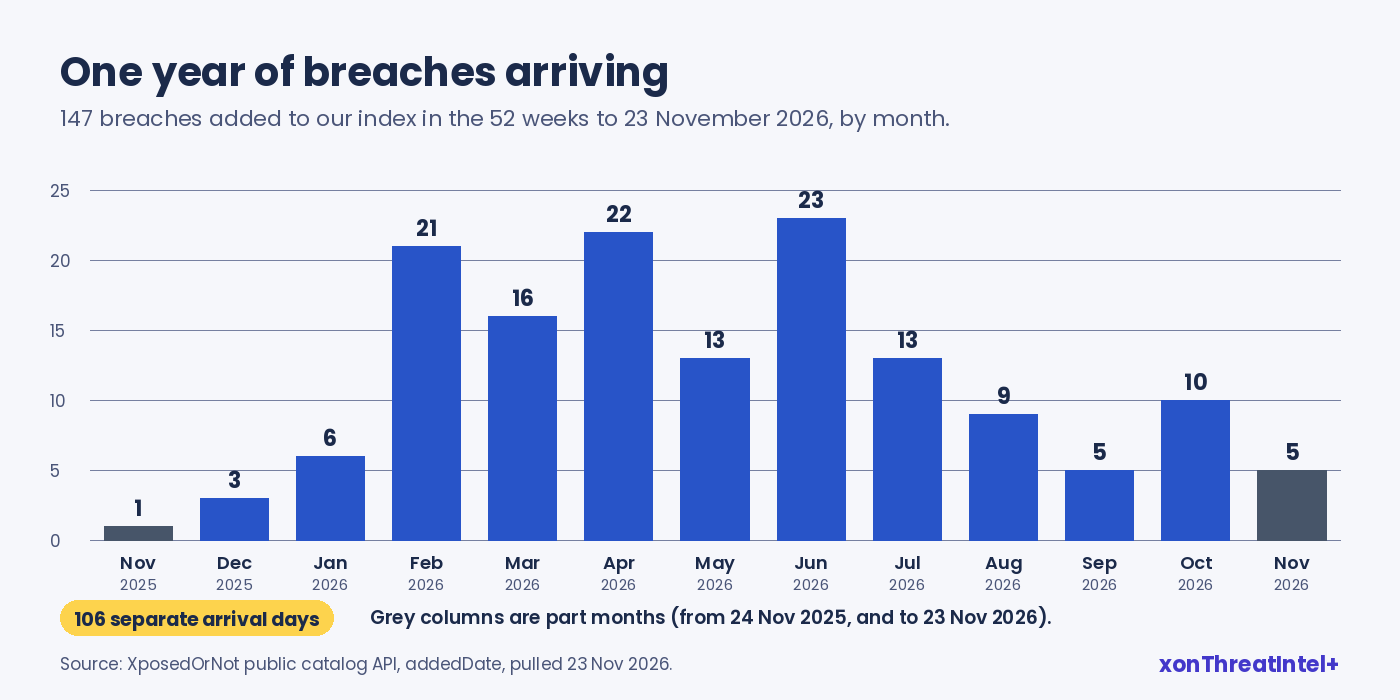
On average that's close to three new breaches a week, each in its own shape. And 41 of the 52 calendar weeks had at least one.
A crawler doesn't do this part. It brings back pages.
The sources won't sit still for you either. A peer-reviewed crawl of 39,536 open onion domains found that 47.8% were offline on any given day (Boshmaf and colleagues, ARES 2023). It reached only sites that need no login, and its data runs to January 2022.
Somebody on your team owns that upkeep: addresses that move, forums that want a login and a captcha, Telegram accounts that get banned, parsers that break when a site changes its layout.
And timing? If you build, your delay is however long your own collection takes.
On xonThreatIntel+ the alert reaches you under 15 minutes for onboarded domains, after a breach lands in our index. The 73-day median in the table is a separate and slower clock, the time breaches take to reach our index in the first place.
Is it legal to collect breach data yourself?
We aren't lawyers and this isn't legal advice. There's a primary source worth reading before you start, though. In February 2020 the US Department of Justice published guidance on gathering cyber threat intelligence from criminal forums (it says of itself that it doesn't have the force of law, and it speaks to US federal criminal law only).
On looking, it's reassuring: passively gathering information from a forum "is unlikely to constitute a federal crime, particularly when done without any criminal intent".
Buying is where it changes, and some dumps are only ever sold. The same paper says "knowingly purchasing another party's stolen data without that party's authorization can pose some legal risk".
For an MSSP the harder question is holding the data. Build your own collection and you become the keeper of other people's passwords, for every client at once, with the storage, access and deletion duties that come with it. (In the EU, GDPR's Recital 49 does recognise security work as a legitimate interest, but you'd still have to document yours.)
A feed changes what you hold. Ours delivers exposure facts (which address, which breach, what kind of data, when) and never raw stolen records. That doesn't remove your own duties, since a client's exposed addresses are still personal data, but it's a far smaller thing to explain to their legal team.
What does each route cost?
We looked for a measured figure on upkeep hours. Nothing we'd trust. What you can do is price it with your own number.
The US Bureau of Labor Statistics puts the median pay for an information security analyst at $62.11 an hour (May 2025). Set our flat monthly prices against that:
| xonThreatIntel+ plan | Price a month | Same money in analyst hours |
|---|---|---|
| 10 client domains | $99 | about 1.6 hours |
| 25 client domains | $243 | about 3.9 hours |
| 50 client domains | $447 | about 7.2 hours |
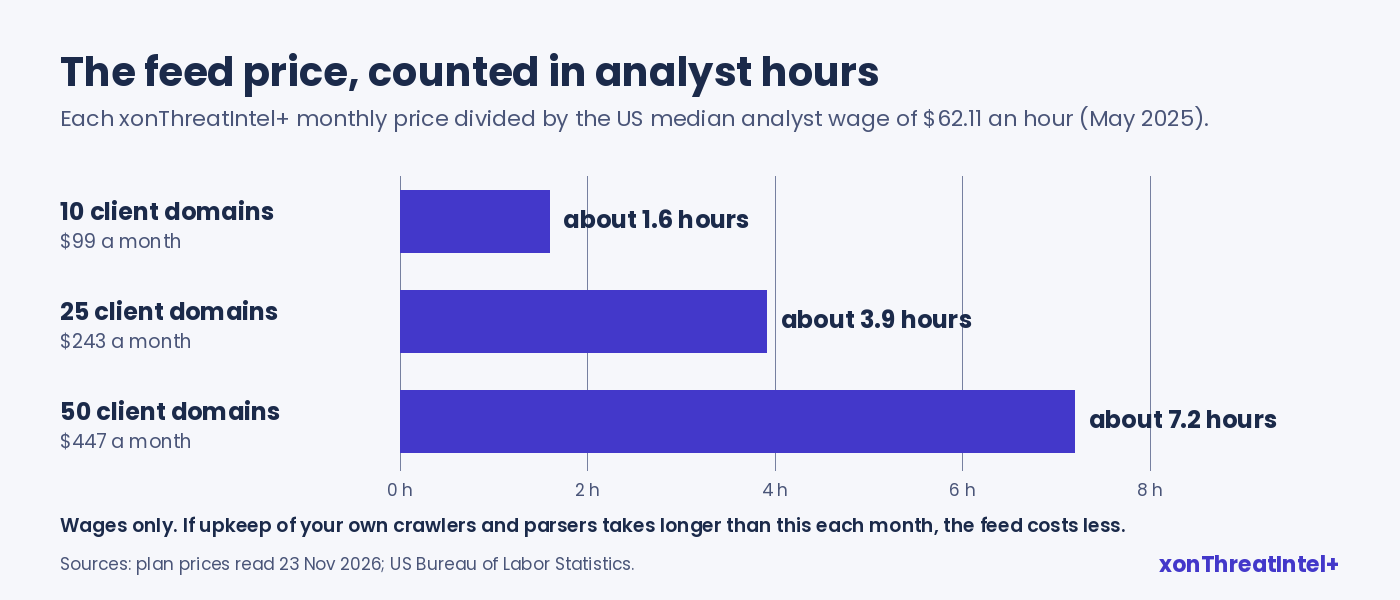
If keeping crawlers, parsers and storage running for 25 clients takes your team more than about four hours a month, the feed costs less for the logins job. That's on wages alone, before servers.
Two caveats, to be fair to the build side. A feed isn't zero hours, because somebody still reads the alerts and calls the client. And your crawlers may be doing a second job (mentions, leak sites) that no breach feed replaces.
Prices are flat with no per-user fees. There's a 30-day money-back guarantee on every plan (no free trial), and the MSSP page lists what each tier includes.
When is open source enough, and when do you buy the data?
Open source on its own is a sound choice more often than vendors admit:
- You have analysts who hunt, and the questions are about mentions and actors.
- You're watching one company. RansomLook's hosted site will show a single SOC when its name appears on a leak page.
- It's a lab, a training range or a research project.
- You already run MISP and mostly need to share and correlate what you've got.
If that's you, a sensible start is RansomLook's hosted site for leak pages, MISP as the store, and AIL once you have somebody to run it. Keep the crawling on a separate machine with no client data on it, because the sites you visit can see you too.
Buy the data when the logins question is the one on the table:
- Clients ask which of their people are exposed, across many domains.
- Your contract promises alerts, and "the crawler was down that week" won't do as an answer.
- Nobody on the team has spare hours for parsers.
- A client wants evidence: which breach, what data, what date.
- You'd rather not have dumps on your own servers.
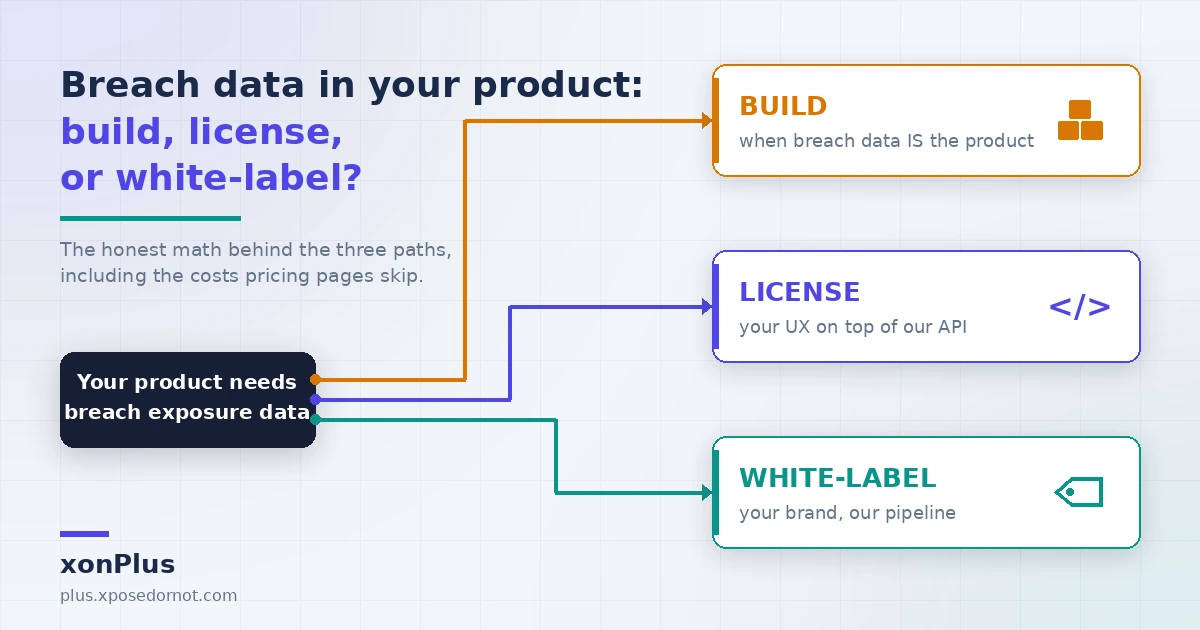
Still weighing whether to build the whole service? Our build, license or white-label guide covers that, and the line between free and paid breach monitoring has its own post.
Running both: an open-source platform with a paid breach feed
Most of the sensible MSSP setups we've seen end up here. They keep the open platform their analysts already know, and feed it breach data they didn't have to collect.
Our side plugs in at two different points, and they're easy to mix up. Inside the platform, an analyst can look up a single email address through the XposedOrNot module in MISP (misp-modules PR 789 , merged 12 July 2026) or the analyzer in Cortex (Cortex-Analyzers PR 1471 , merged 5 October 2026). Wazuh is on the integrations list too.
The xonThreatIntel+ feed is separate. Every tier alerts by email, Slack and Teams, and the account webhook and JSON feeds come with the $243 tier and up. You route those into your platform yourself.
What lands on the analyst's screen differs a lot. A plain crawler hit looks something like this (made up, and the bare case; AIL would hand you more structure):
url:      http://exampleforumxyz.onion/thread/48213
title:    "fresh corp logs, 2k lines"
matched:  keyword "northwind"
Is that a real leak, an old one reposted, or someone bragging? Hard to say. Somebody has to go and find out.
A webhook notification for the same client ($243 tier and up) looks like this:
{
  "event": "new_findings",
  "as_of": "2026-10-20T11:42:07Z",
  "domains": [
    {"domain": "northwind.example", "new_breaches": ["SampleProjectTool"], "new_records": 6}
  ]
}
It names the client domain, the breach and the count, and it never carries an email address. It's the trigger to pull the addresses afterwards through the API.
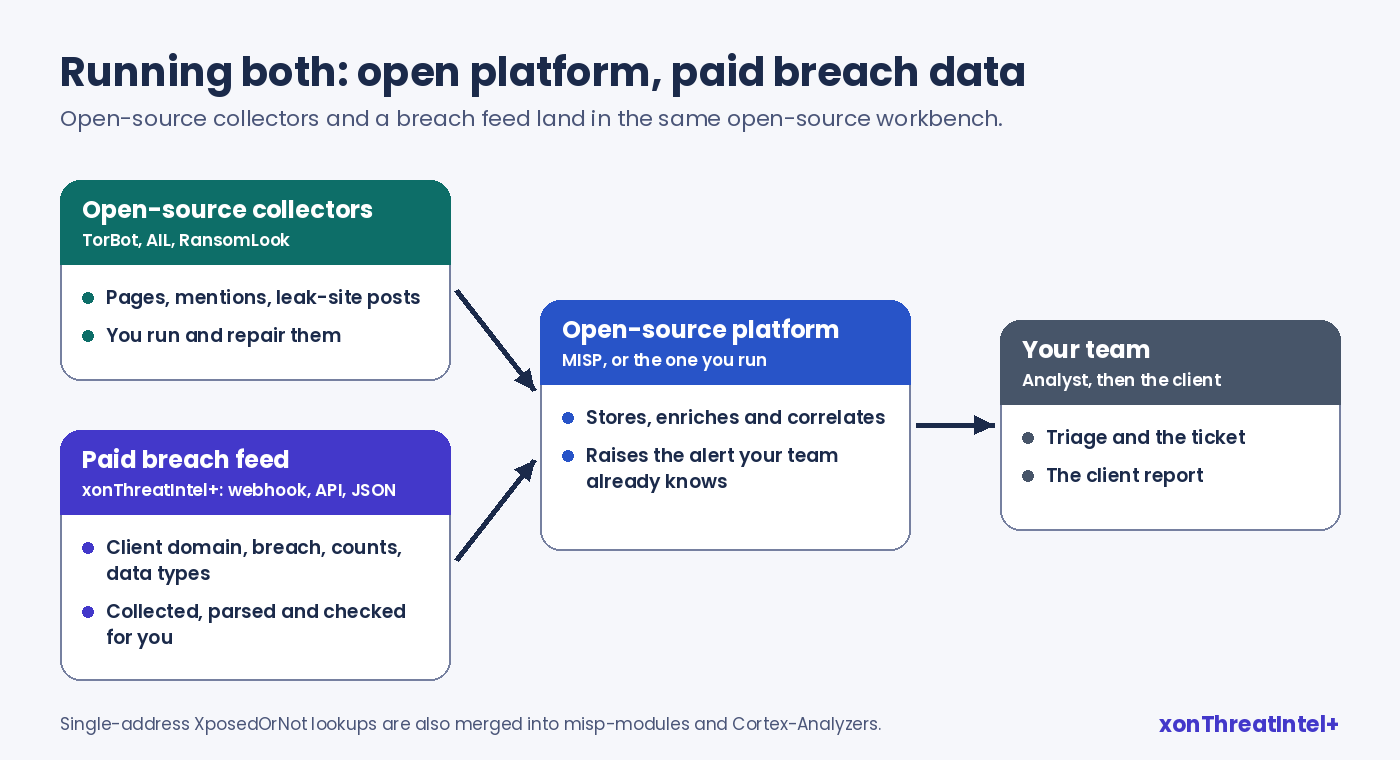
Home-built crawlers strain most once there are many clients, because one crawler serves one watchlist. On xonThreatIntel+ one account, one API key and one domain quota cover every client domain, and our post on multi-tenant monitoring shows how alerts fan out per client. (Stealer logs are their own source with their own quirks; this guide for MSSPs walks through them.)
Before you choose: six questions
- Which of the three jobs did the client actually ask for?
- For every repo you'd depend on, when was the last commit, and is there a licence file?
- Who fixes the crawler when an onion address moves? What about when they're on leave?
- Which machine touches these sites, and is any client data on it?
- Where does collected data live, who can read it, and when is it deleted?
- How many hours a month will it take? Multiply by your rate and set it beside the feed price.
If the answers lean towards buying the data, the MSSP plans start at $99 a month for 10 client domains. Your own company's domain you can watch for free on XposedOrNot , whichever way you go.
Quick answers
Is there an open-source dark web monitoring tool?
There are many, each doing one part of the job: TorBot and Ahmia crawl and search onion sites, RansomLook tracks ransomware leak pages, AIL collects and analyses leaks, and MISP stores and shares what you find. None of the 32 we checked on 23 November 2026 ships a searchable history of past breaches.
Can I build my own dark web monitoring for clients?
Yes, and for mentions and leak-site tracking it can work well. Checking staff logins against breaches needs a breach collection, which you'd have to gather, parse and keep current yourself. Our own index took in 147 breaches in the 52 weeks to 23 November 2026.
Is it legal to collect breach data for clients?
Rules differ by country, so ask a lawyer. US Department of Justice guidance from 2020 treats passive collection from forums as unlikely to be a federal crime, and says knowingly buying someone else's stolen data "can pose some legal risk".
Can I use MISP with a paid breach feed?
Yes, and it's a common setup: MISP holds and correlates, and the feed supplies the breach data. Every xonThreatIntel+ plan includes API access, and the account webhook and JSON feeds come with the $243 tier and up. Single-address lookups also work from inside MISP through the XposedOrNot module.
Where the numbers came from
- Project status: 32 public GitHub repositories read on 23 November 2026 (licence and archive flag from the GitHub API, newest commit from each default branch). "Dormant" means no commit in two years, or a README that says the project is unmaintained (Fresh Onions and Telepathy say so themselves).
- TheHive licence: the TheHive repository README and the vendor's licence page , read 23 November 2026.
- XposedOrNot public catalog,
api.xposedornot.com/v1/breaches, pulled 23 November 2026: 801 breaches, 11,727,783,489 records. Fields used:addedDate,breachedDate,exposedRecords,exposedData. The 52-week window covers breaches added after 24 November 2025. - Breach-to-index gap: median 73 days across the 147 breaches added in the 52 weeks to 23 November 2026. Breach dates carry month precision. Other posts quote other windows.
- Boshmaf, Perera, Kumarasinghe, Liyanage and Al Jawaheri, Dizzy: Large-Scale Crawling and Analysis of Onion Services , ARES 2023.
- US Department of Justice, Cybersecurity Unit, Legal Considerations when Gathering Online Cyber Threat Intelligence and Purchasing Data from Illicit Sources , version 1.0, February 2020.
- US Bureau of Labor Statistics, Occupational Outlook Handbook, Information Security Analysts : median pay $62.11 an hour, May 2025.
- Product facts: xonThreatIntel+ and the MSSP plans, read 23 November 2026.