Password Reuse Statistics 2026, With a Breach-Dump Reality Check
Ask a room of staff whether they reuse passwords and roughly half will put a hand up. Count the tweaked ones too ("Summer2024!" becoming "Summer2025!") and one small study found it was most of their passwords.
Which number is right depends on what's being counted.
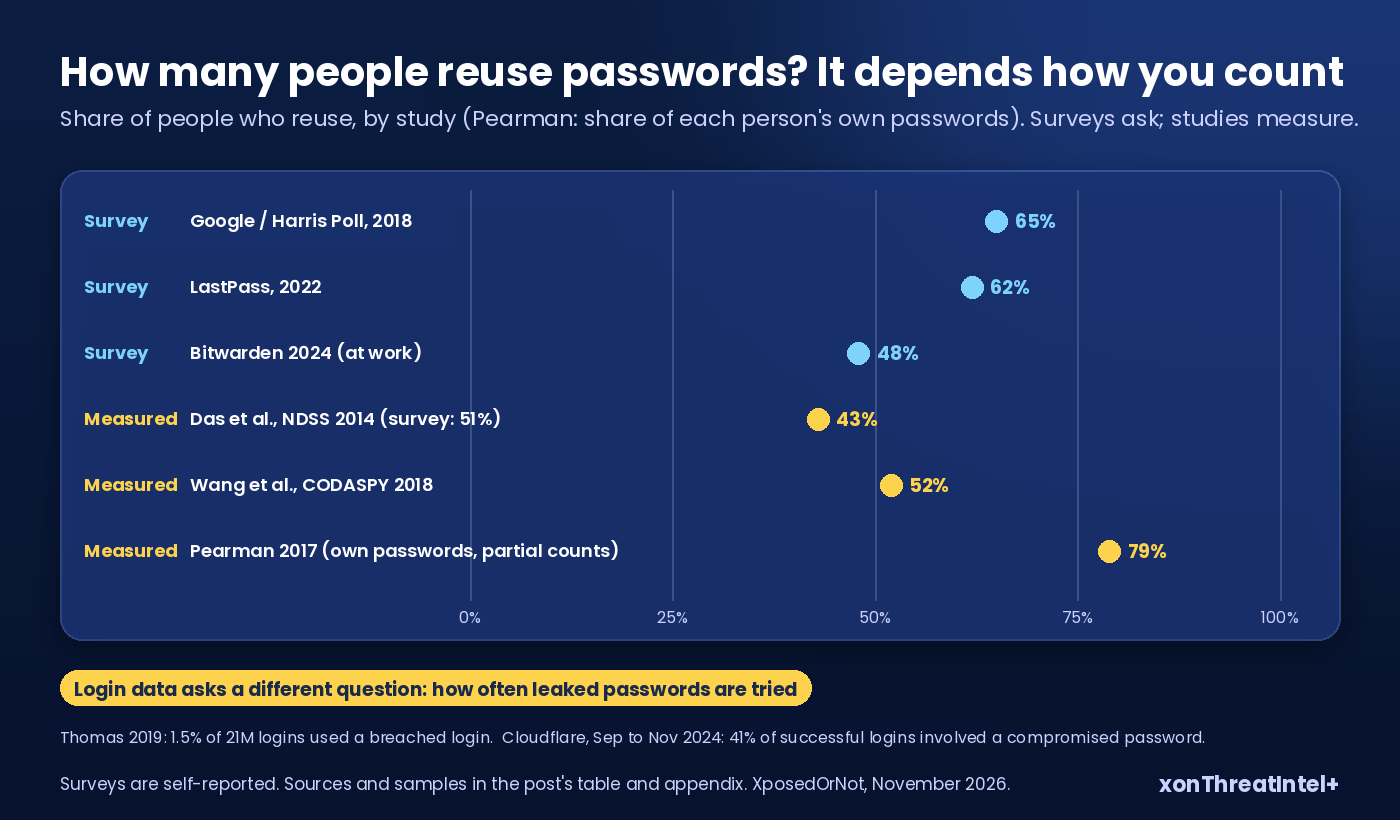
Self-reported surveys land between 48% and 65%. Measured studies put exact reuse at 38 to 43% of users, or 52% once modified passwords count. And on one large network's login traffic, 41% of successful logins involved a leaked password.
We run xonThreatIntel+, the partner side of the XposedOrNot breach index. It holds 798 breaches and 11.7 billion+ records as of 10 November 2026. The second half of this post is what those dumps add. (Every count here is a count of records, and one person can sit in dozens of breaches. Our data page explains the counting.)
How many people reuse passwords?
Depends who's counting, and how. Every number worth quoting is below, sorted by method, with its date.
| Method | Finding | Source, year | Sample |
|---|---|---|---|
| Survey (self-reported) | 65% reuse a password across some or all accounts (52% some, 13% all) | Google / Harris Poll, Dec 2018 | 3,000 US adults |
| Survey (self-reported) | 62% always or mostly use the same password or a variation | LastPass, 2022 | 3,750 professionals |
| Survey (self-reported) | 48% reuse passwords across workplace accounts somewhat or very frequently | Bitwarden, 2024 | 2,400 people, six countries |
| Measured (peer-reviewed) | 43% reuse the same password across sites in leak data; 51% in the same paper's survey | Das et al., NDSS 2014 | 6,077 users in leaked data; 224 survey responses |
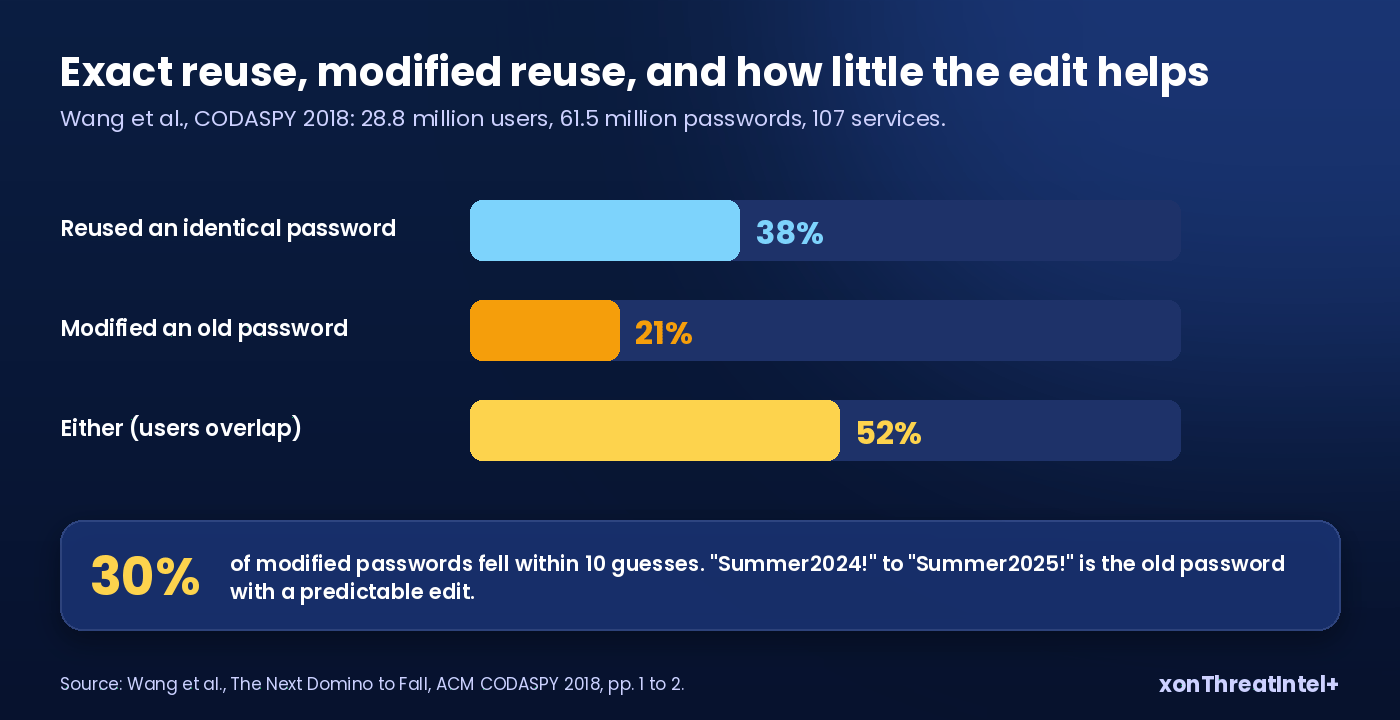
| Measured (peer-reviewed) | 52% reused (38%) or modified (21%) a password across services (some did both) | Wang et al., CODASPY 2018 | 28.8 million users, 107 services |
| Measured (peer-reviewed), per person | The average participant reused 79% of their own passwords, exactly or partly | Pearman et al., CCS 2017 | 154 home users, 147 days on average |
| Login telemetry | 1.5% of logins used a breached username and password | Thomas et al., USENIX Security 2019 | 21 million logins, self-selected users |
| Login telemetry | 41% of successful logins involved a compromised password | Cloudflare, Sep to Nov 2024 | Cloudflare-protected sites |
| Login telemetry | Median 19% of daily SSO authentication attempts were credential stuffing (25% at enterprises, 12% at small firms) | Verizon DBIR team, Mar 2025 | 2,301 organizations |
That "65%" you've seen everywhere? It's the Harris figure, from a survey run in December 2018 (the original infographic ). It's almost eight years old and it's self-reported, so treat it as history.
Why the numbers disagree
Surveys ask people what they do. You'd expect them to under-report, but they don't always: Das et al. found their survey figure (51%) above their leak-data figure (43%). LastPass's own 2022 survey found only 31% stopped reusing passwords after security training.
Measured studies count what people do, but they count differently. Das et al. (NDSS 2014) counted exact matches. Pearman et al. (CCS 2017) counted a shared run of four or more characters as partial reuse, which is how the average participant reached 79% of their passwords.
Login telemetry measures something else again: how often a leaked password is actually tried, or works. Cloudflare's 41% is a share of successful logins on its own customers' sites. And 95% of the login attempts using leaked passwords came from bots.
Different question, different number. None of them is wrong. For a security lead they point the same way: a work address in someone else's breach may share its password with work.
Exact reuse vs "I added a 1"
This is the part most stat pages skip, and it's the part attackers like most.
Wang et al. (CODASPY 2018) followed 28.8 million users across 107 services. 38% reused an identical password somewhere. Another 21% modified an old one. And modification barely helps: more than 16 million password pairs, including 30% of the modified ones, fell within 10 guesses.
Das et al. found the same thing earlier. Their cross-site guessing method got 30% of transformed passwords within 100 attempts, against 14% for a standard approach.
So "Summer2024!" to "Summer2025!" isn't a new password. It's the old one with a predictable edit. And "but I changed it" is little comfort when a work address turns up in a password dump.
How long a leaked password stays dangerous
Longer than you'd hope. In the Wang data, more than 70% of users were still reusing an already-leaked password on other services a year after the leak. 40% were reusing one leaked more than three years earlier. Both figures are inferred, mind you: the same people turned up in later leaks with the old password, and nobody watched their logins.
And warnings only move some people. Google's Password Checkup study (Thomas et al., USENIX Security 2019) found 26% of its breach warnings led to a new password at least as strong as the old one. Its users had opted in by installing the tool, so they were likely keener than most.
The other 74% of warnings didn't end in a stronger password.
In our experience that matches what security teams see. The leak happens once. The reuse sits there for years.
It's also why an older breach that lands in our index today shows up as a new finding for your domain today.
Where it meets your company
From someone's shopping login to your SSO, then.
The Verizon DBIR team's credential-stuffing research (March 2025) looked at SSO provider logs from 2,301 organizations over two years. The median day, 19% of all authentication attempts were credential stuffing. Enterprise-sized companies saw 25%.
The same research looked at devices infected by infostealer malware. In the median case, only 49% of a person's saved passwords were distinct from each other (a skewed group, since these were infected devices).
The 2025 DBIR says the quiet part plainly. So many sites use an email address as the login that a reused pair is "very useful for criminals" (p. 82). For a security lead, that's the line that matters: the email address is the join key.
The breach-dump reality check
So what does the raw material look like? Our catalog on 10 November 2026, counted from the live API:
| Measure (catalog as of 10 Nov 2026) | Entries | Records | Share |
|---|---|---|---|
| All breaches | 798 | 11,718,210,957 | 100% of records |
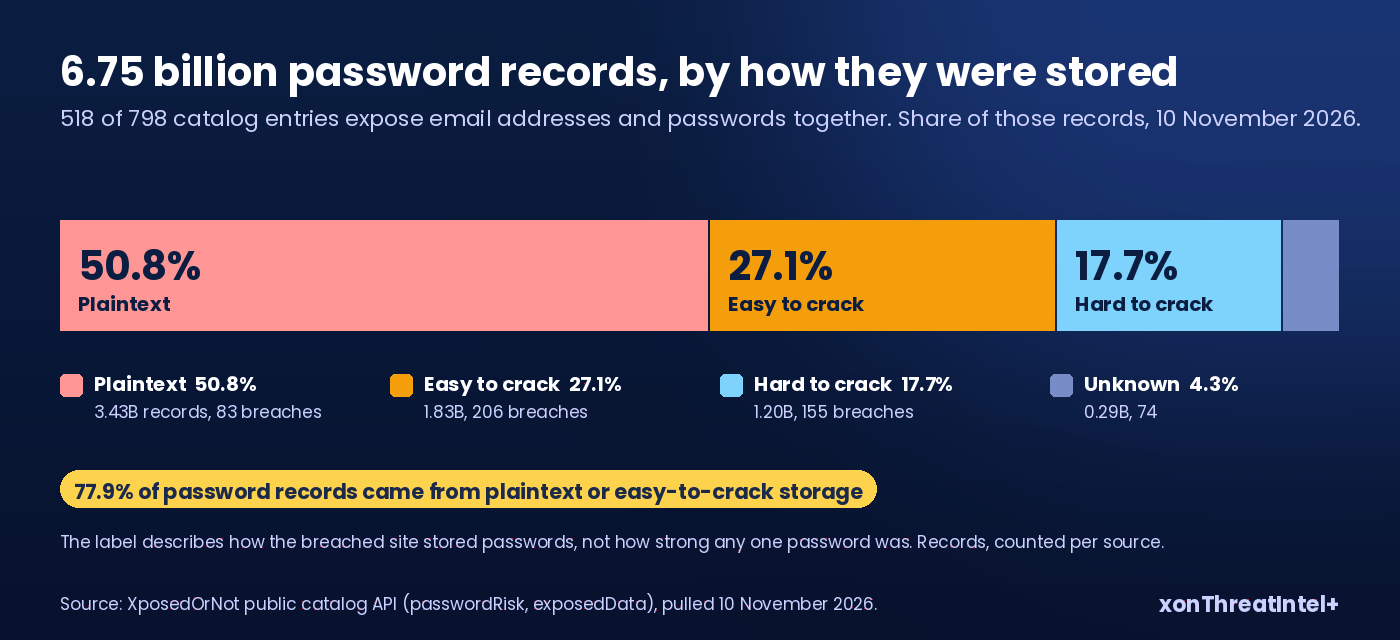
| Expose email addresses and passwords together | 518 | 6,750,177,372 | 57.6% of records |
| Of those, passwords stored in plaintext | 83 | 3,429,656,334 | 50.8% of password records |
| Of those, stored in an easy-to-crack form | 206 | 1,829,662,224 | 27.1% of password records |
| Combolists and stealer logs with passwords | 5 | 1,732,930,708 | 25.7% of password records |
Rows three and four are the uncomfortable bit. Between them, they're over three-quarters of the password-exposing records in our catalog.
(That label's about how the site stored passwords, by the way, not whether anyone picked a good one.)
The last row is the reuse fuel. Four of those five are combolists, recycled pairs bundled for trying on other sites; the fifth, AlienStealerLogs, was lifted straight off infected devices. Our community post on password storage across 516 breaches (September 2026) goes deeper on the storage labels.
Is it getting better?
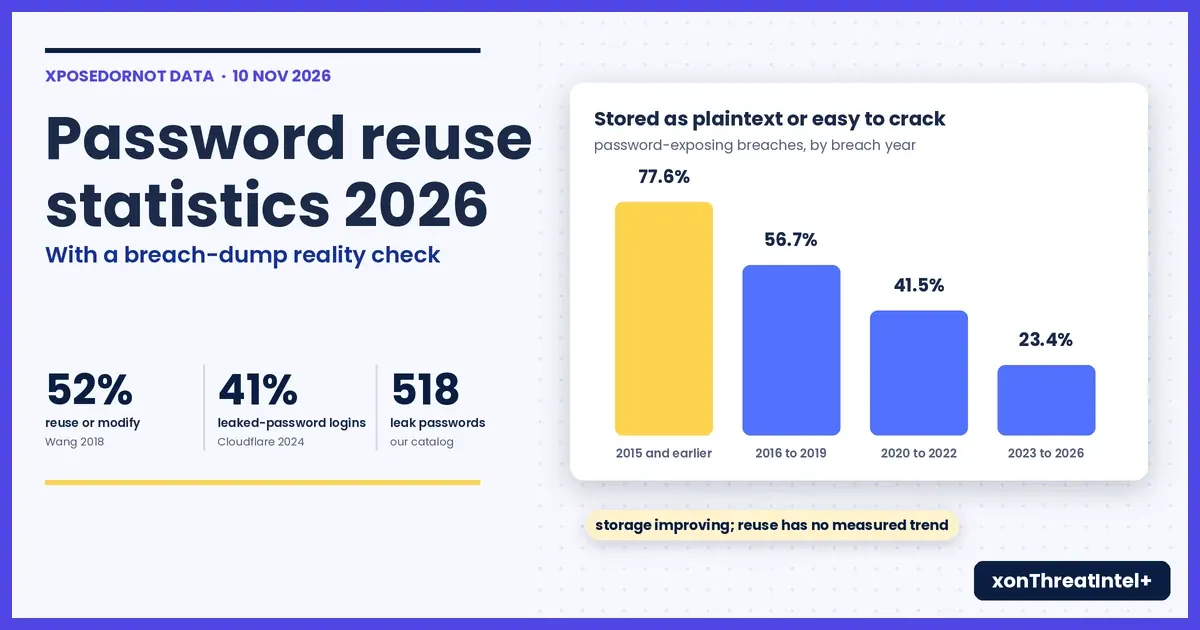
Storage is. Reuse has no measured trend: none of the studies above tracks it over time.
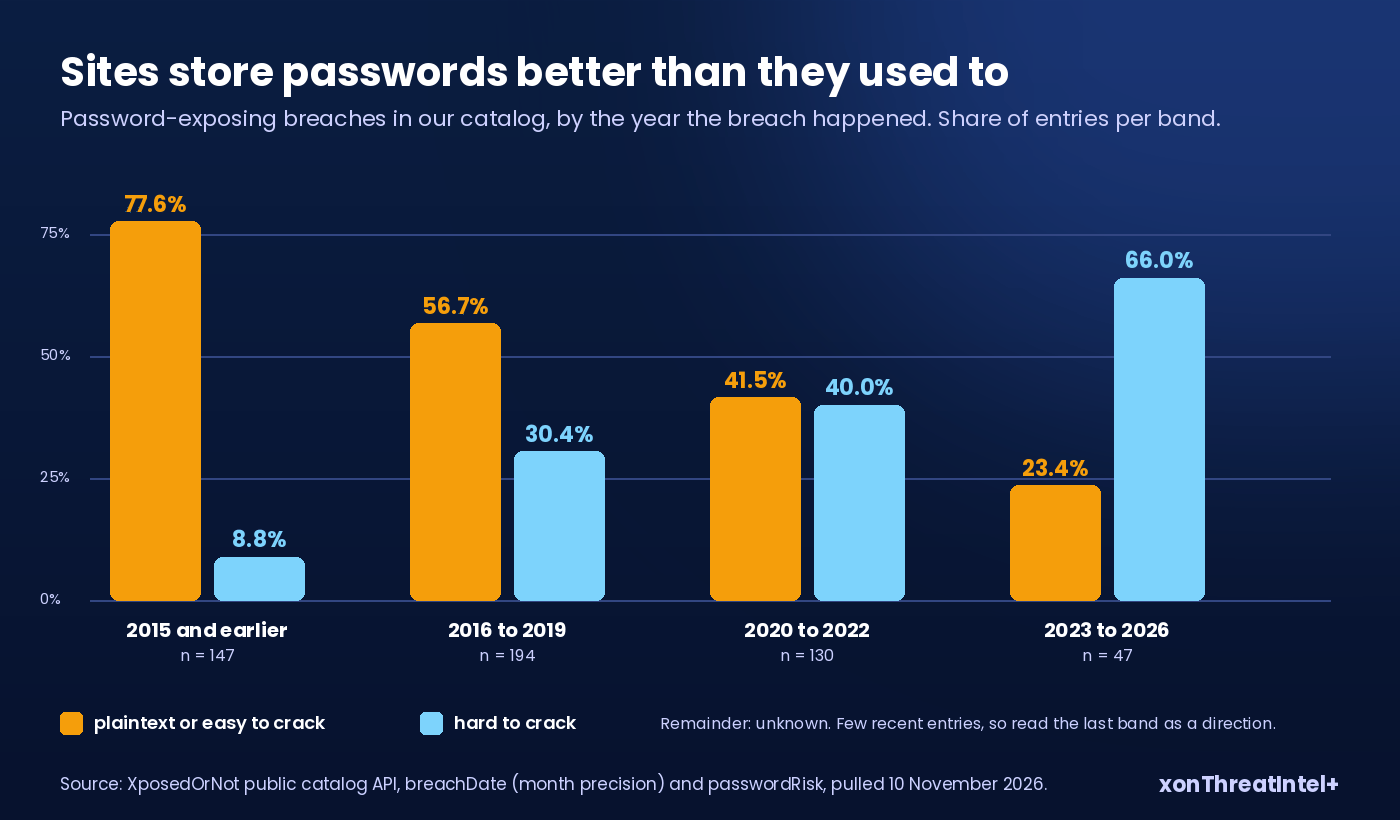
Sort the 518 password-exposing breaches by the year they happened and the share stored as plaintext or easy-to-crack falls steadily:
| Breach year (password-exposing entries) | Entries | Plaintext or easy to crack | Hard to crack |
|---|---|---|---|
| 2015 and earlier | 147 | 77.6% | 8.8% |
| 2016 to 2019 | 194 | 56.7% | 30.4% |
| 2020 to 2022 | 130 | 41.5% | 40.0% |
| 2023 to 2026 | 47 | 23.4% | 66.0% |
Good news, mostly. One catch, though. Good hashing only ever protects the site doing it.
Think of the person whose password leaked in plaintext from some 2016 forum, and who used it again at a 2024 shop that hashed everything properly. The shop's care doesn't help them a bit.
Go easy on the newest band, though. It holds just 47 entries, and sources only date a breach to the month, so treat the table as a direction.
And the flow hasn't stopped. In the 52 weeks to 10 November 2026, 35 of the 145 breaches we added exposed passwords, 405 million records. One stealer-log collection, AlienStealerLogs, accounts for 299.6 million of them on its own (why stealer-log hits read differently).
What a company can actually see
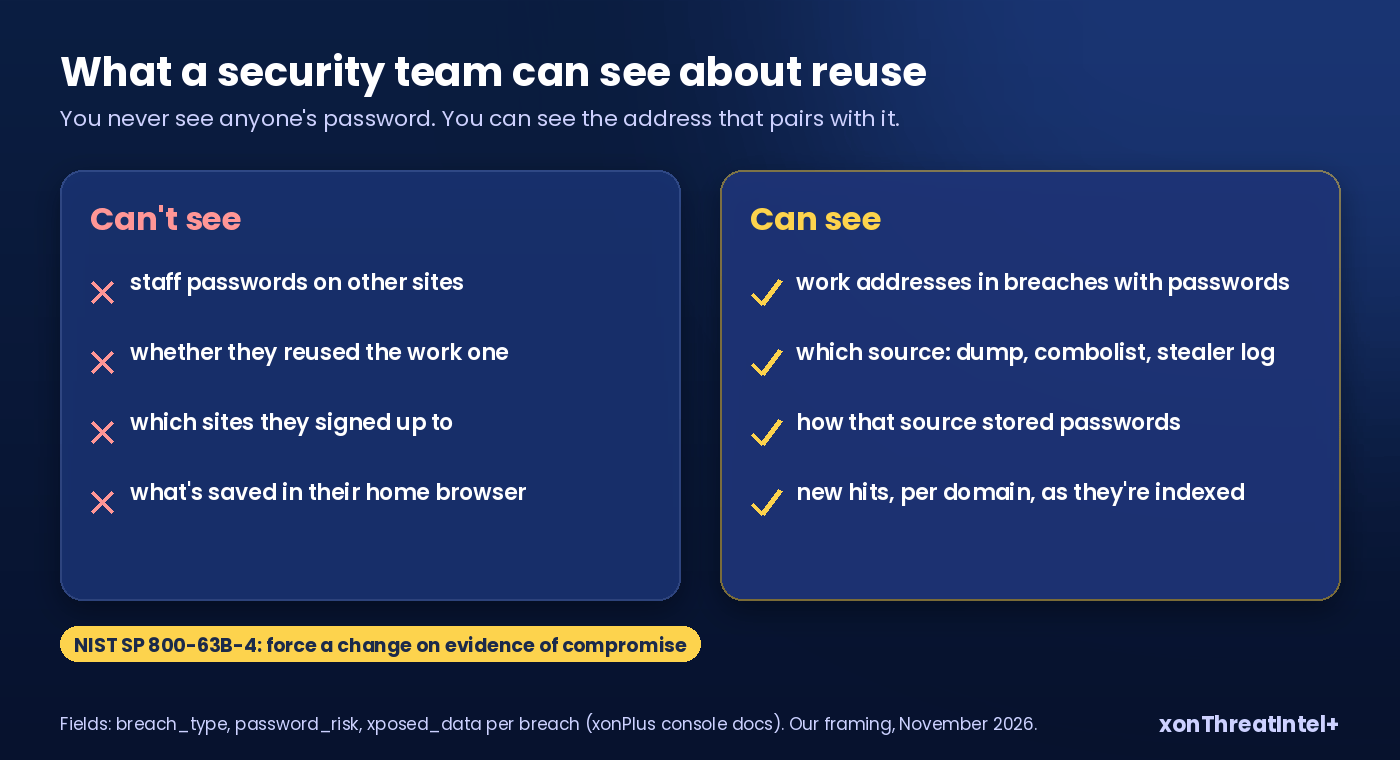
You can't see your staff's passwords on other sites. And you shouldn't want to.
What you can see is their work addresses turning up in breaches and stealer logs that exposed passwords. That's the signal that matters. The address is the login, and the password may well be the one they use at work.
NIST SP 800-63B-4 sets the rule. No more forced periodic changes, but verifiers "SHALL force a change if there is evidence that the authenticator has been compromised" (Sec. 3.1.1.2). Whether a work address in another site's dump counts as that evidence is a judgement call.
Our view: a work address in a fresh password dump is reason enough to reset that account and check its sign-ins. The alert is how you find out.
For your own company's domain, that monitoring is free at xposedornot.com/domain . For client domains, xonThreatIntel+ checks every breach and stealer log that lands in our index against the domains you onboard. Alerts arrive under 15 minutes for onboarded domains, after a breach lands in our index.
The domain detail then lists the exposed addresses, with each breach's breach_type, password_risk and xposed_data. That's how you tell a plaintext stealer-log hit from an old hashed dump.
A short checklist for security leads
Order matters here, so it's numbered.
- Turn on domain monitoring for every domain your staff log in with (your own is free; client domains on xonThreatIntel+ for MSSPs).
- Work stealer-log hits with plaintext passwords first. Malware stole a saved login from a device, so open an endpoint ticket as well.
- Then combolist hits, then fresh breaches with plaintext or easy-to-crack storage. Old hashed dumps on people who've left go last.
- For each live account: revoke sessions, then reset, then check recent sign-ins. Our corporate account takeover checklist covers what to look for.
- Put step-up checks on accounts that just appeared in a dump (how to wire that).
- Drop the 90-day rotation; NIST SP 800-63B-4 says verifiers shall not require it. Change a password when there's evidence of compromise instead.
- Tell staff why, without ever asking for a password. "Your work address was in a breach of another site" is enough.
Quick answers
What percentage of people reuse passwords?
In measured studies, 38% to 43% of users reuse an identical password, rising to 52% once modified passwords count. Self-reported surveys say 48% to 65%; the often-quoted 65% comes from a Google and Harris Poll survey run in December 2018.
How many people reuse passwords at work?
In Bitwarden's 2024 survey of 2,400 people, 48% said they reuse passwords across workplace accounts somewhat or very frequently. It's a self-reported survey from a password-manager vendor. Read it as what people admit to, not a measurement.
Is password reuse getting better?
Password storage is improving: in our catalog, plaintext or easy-to-crack storage fell from 77.6% of password-exposing breaches dated 2015 or earlier to 23.4% for 2023 to 2026. None of the reuse studies here tracks a trend over time, and a strong hash on one site doesn't protect a password sitting in plaintext elsewhere.
What's the difference between password reuse and credential stuffing?
Reuse is the habit: one password on several sites. Credential stuffing is the attack that exploits it, where bots try leaked email and password pairs on other logins at scale. One feeds the other.
Does a password manager stop password reuse?
It helps, but less than you'd think. Pearman et al.'s in-home study found password managers "may have no impact" on reuse. In Bitwarden's 2024 survey, 45% of people who adopted one said they reuse less often (self-reported).
Where the numbers came from
- Catalog figures: XposedOrNot public API (
/v1/breachesand/v1/metrics), pulled 10 November 2026: 798 breaches, 11,718,210,957 records; 518 entries expose email addresses and passwords (6,750,177,372 records); password records by the source's storage label; breach-year bands by breach date (month precision); 145 breaches added in the 52 weeks to 10 November 2026, 35 with passwords (405,206,688 records). Counting rules on our data page. - A. Das, J. Bonneau, M. Caesar, N. Borisov, X. Wang, The Tangled Web of Password Reuse , NDSS 2014.
- C. Wang, S. T.K. Jan, H. Hu, D. Bossart, G. Wang, The Next Domino to Fall: Empirical Analysis of User Passwords across Online Services , ACM CODASPY 2018.
- S. Pearman et al., Let's Go in for a Closer Look: Observing Passwords in Their Natural Habitat , ACM CCS 2017.
- K. Thomas et al., Protecting accounts from credential stuffing with password breach alerting , USENIX Security 2019.
- Verizon, Additional 2025 DBIR research on credential stuffing , 17 March 2025; 2025 Data Breach Investigations Report , p. 82.
- Cloudflare, Password reuse is rampant , 17 March 2025 (traffic September to November 2024).
- Google / Harris Poll, Online Security Survey , survey December 2018.
- LastPass, Psychology of Passwords 2022 (self-reported survey).
- Bitwarden, World Password Day Survey 2024 (self-reported survey).
- NIST, SP 800-63B-4 , Sec. 3.1.1.2 (July 2025).